



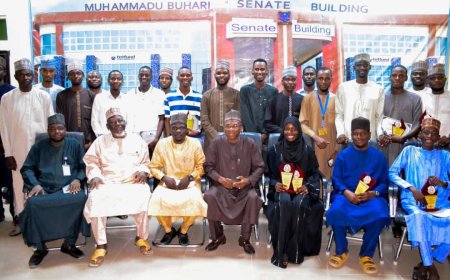


UNIMAID CENTRE FOR NATIONAL WATER RESOURCES HOSTS SECOND INTERNATIONAL CONFERENCE ON WATER, CLIMATE AND BUILDING COMMUNITY RESILIENCE IN THE FACE OF FLOOD


The University of Maiduguri, in collaboration with the Northeast Regional Centre of the National Water Resources Capacity Building Network (NWRCBN), successfully hosted the second International Conference on “Water, Climate, and Community: Building Resilience in the Face of Flood” on Monday at the Muhammadu Indimi Conference Centre. The conference which was attended by dignitaries both within and outside the University Community was focused on addressing the growing threat of flooding and its broader environmental and social implications.
In his welcome address, the Vice-Chancellor, Professor Mohammed Laminu Mele, represented by the Dean, Faculty of Physical Sciences, Professor Ibrahim Goni, underscored that water is not simply a resource, it is the lifeblood of our communities which sustains our agriculture, drives our economies, and underpins the very fabric of our society. He, however noted that due to increasingly erratic rainfall patterns, exacerbated by climate change, this vital resource is transforming into a potential threat. He stated that "We have witnessed first-hand the destructive power of floods, which displaced communities, destroyed livelihoods, and inflicted lasting trauma on individuals and families here in Maiduguri and some other states as well".
Professor Babagana Kolo, the Director of the Centre for National Water Resources Capacity Building Network (NWRCBN), University of Maiduguri, in his remarks, emphasized the centre’s role in providing multidisciplinary training and research in areas such as Integrated Water Resources Management (IWRM), Water Quality Management, Irrigation and Drainage Technology, as well as Water Sanitation and Hygiene (WASH). He also stressed the need for proactive health and safety strategies to reduce the socio-environmental impacts of flood disasters.
Delivering the keynote address, Dr. Abubakar Dauda Iliya, the Executive Director, Finance and Administration at the North East Development Commission (NEDC), identified climate change, deforestation, inadequate infrastructure, poor waste management, and the absence of early warning systems as major drivers of flooding in the region. He noted that flooding has become a recurring disaster, impacting lives, farmlands, and livelihoods.
The conference also drew participants from academia, government agencies, development partners, and the students community, who presented papers, engaged in dialogue and knowledge exchange geared towards enhancing community resilience and sustainable water management.


What's Your Reaction?